Explore the results of the AI Impact 2026 survey and discover the factors that are driving or limiting AI in different industries.
15 Jul 2026 10 min read
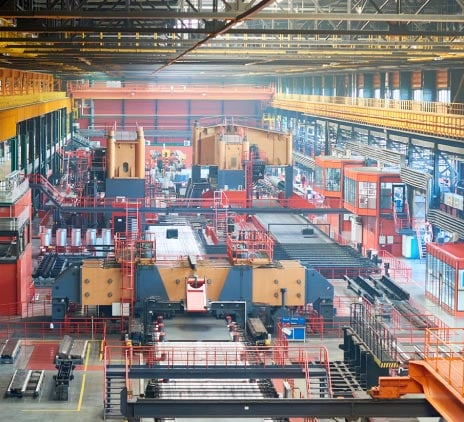
The manufacturing industry has already implemented AI, captured efficiency gains, and developed confidence in operational applications of the technology. What most manufacturers haven't built yet is the infrastructure needed to prove that AI is delivering results: trackable decisions, controls that can withstand scrutiny, and a tested plan to respond when something doesn't turn out as expected.
Grant Thornton's 2026 AI Impact survey, conducted with 950 business leaders, shows that this gap is particularly relevant in the manufacturing industry. The results are expressive. Among manufacturing industry respondents, none reported significant revenue gains from AI initiatives, compared to 12% of executives across all industries. Similarly, none pointed to significant cost savings, while the overall average was also 12%. In addition, nearly half (47%) of industry leaders said AI generated only a small increase in revenue.
The manufacturing industry focuses AI in operations more than any other industry: 62% identify operations as the area most in need of additional AI focus. It is precisely in this environment that margins are gained or lost in real time and where AI failures can generate immediate financial and security consequences. The combination of high adoption and low proof of readiness defines one of the industry's key challenges for 2026.
Many manufacturers have already realized efficiency gains from using AI in operations, laying the foundation of their artificial intelligence strategies. However, these organizations have implemented the technology without building the governance infrastructure necessary to prove that these outcomes are sustainable, scalable, and defensible. This gap limits your ability to advance to the next stage of maturity and value creation with AI.
While 48 percent of manufacturing companies are still piloting AI, only 10 percent have been able to fully integrate the technology into operations, four points below the average for all industries. It is precisely in this distance between pilot projects and operational integration that the gap in results lies.
Organizations with fully integrated AI are much more likely to report revenue growth, accelerated innovation, and improved quality of the results generated. While many manufacturers continue to conduct tests, evidence of performance is being built by organizations that have already passed this step. At the other extreme, only 39% say they are extending AI to multiple functions in the company, a rate 10 percentage points below the overall average of the survey (49%).
AI is reducing the transformation time that, in previous technology cycles, took a decade to occur. Grant Thornton's experts in the manufacturing industry note a recurring pattern: many companies purchase AI solutions and wait for their technology vendors to define how to implement them.
Many manufacturers remain stuck in the testing phase because they lack a governance infrastructure driven by the organization's leadership. This structure is essential to support a more proactive AI strategy capable of positioning the company ahead of competitors.
Currently, many AI investment decisions are driven by reactions to market and technology vendor movements, rather than being aligned with a deliberate strategy of generating margins and creating value. As a result, part of these investments may be directed to priorities that do not generate the highest return for the business.
Still, manufacturing industry leaders rank creativity and an innovation-driven mindset as the top leadership attribute for the AI era, cited by 48 percent of respondents, 12 points above the average for all industries.
An innovative mindset can yield concrete applications, such as predictive quality control capable of identifying defects before production, AI-accelerated development cycles, dynamic supply chain reconfiguration in the face of real-time disruptions, and predictive maintenance and asset management initiatives based on operating conditions. To capture the full potential of technology, leaders need to accelerate innovation.
In addition, the efficiency gains obtained today have an expiration date, especially when all competitors also achieve them. The real competitive differentiator lies in the use of operational AI to support real-time decisions related to productivity, purchasing, and production scheduling.
AI-driven purchasing decisions can adjust supplier allocation based on up-to-date cost and risk information, reflecting their financial impacts in the same quarter. Production scheduling models can optimize the volume produced considering energy costs, with measurable effects on financial results. AI-backed quality control systems can reduce waste in ways that are directly attributable to technology.
When operational AI is connected to real-time financial results, manufacturers can clearly demonstrate the value generated by their investments. This link between operational decisions and financial performance will be essential to the next phase of AI-based competitive advantage in the manufacturing industry. Operations leaders need to drive this evolution now, because the efficiency gains that today represent a competitive differentiator will soon be just a basic requirement to compete.
Explore the results of the AI Impact 2026 survey and discover the factors that are driving or limiting AI in different industries.
Half of manufacturing industry leaders (50%) said formalizing an AI strategy or governance framework is the most important change their organizations need to make in the next six months. This may be related to the fact that only 7% have a defined and tested AI incident response plan, the lowest percentage among all industries surveyed.
In other words, out of every 100 manufacturing industry leaders surveyed, 93 are operating AI in production environments, assembly lines, supply chains, or quality systems without having previously tested how they will respond when something goes wrong.
In an industry accustomed to performing security simulations, testing backup generators, and running crisis protocols for physical systems, the AI capabilities that operate alongside these systems still don't go through the same level of preparation. This highlights a significant contrast between how the manufacturing industry treats physical risk preparedness and how it addresses the risks associated with AI.
Only 14 percent of manufacturers consider their organizations to be extremely prepared to address AI-related privacy and security challenges, the lowest among all industries surveyed, compared to the overall average of 40 percent.
When an AI failure occurs in an operational environment, whether it's an error in quality controls, a failure in production scheduling sequences, or an inappropriate purchasing decision, organizations without a tested response plan discover the cost of these failures directly in production, not just in their policies or procedures.
Manufacturers with operations in different states face inconsistent regulatory guidance and the absence of a unified federal regulatory standard. Organizations that are moving faster are building their governance infrastructure now, as it is the evidence generated before regulatory pressure that creates the trust needed to scale AI when the moment calls for it. Waiting for greater regulatory clarity is a decision that brings measurable costs.
At the board level, organizations in the manufacturing industry are already approving investments in AI. 79% of respondents say their boards have approved significant investments in the technology.
However, fewer boards are moving on to the next step: establishing formal AI governance policies. Only 42% of manufacturing industry organizations have such policies in place, compared to 52% on average for all industries.
Investments are advancing faster than governance, creating increasing risk for organizations. Without clear controls, scaling an AI pilot not only amplifies your value-generating potential, but also your exposure to risk.
The strategy is pointed out by most manufacturers as the element that most contributes to generating results with AI. However, in practice, it is the movements of the competition that are driving a large part of their decisions. Many companies in the manufacturing industry claim to believe in the importance of strategy, but they continue to react to competitors' actions. This difference can already be seen in the results related to innovation.
An AI strategy for the manufacturing industry based solely on observing competitors tends to direct investments to initiatives that other market participants have already implemented. An effective strategy must answer fundamental questions: which decisions directly impact our margin structure, where AI can generate most relevant benefits in the operating model, and who is responsible when AI influences a business outcome.
Governance can help organizations define an AI strategy focused on the needs with the greatest impact on the business. In addition, it allows you to control, monitor, and scale these solutions securely. An autonomous quality inspection system can identify defects in real-time, but it requires governance to continually verify that detection limits remain adequate as production conditions evolve.
A predictive maintenance agent who schedules interventions without human approval needs governance mechanisms capable of assessing whether these actions are effectively reducing unplanned downtime or creating unnecessary disruptions.
Similarly, an AI-based procurement system that automatically adjusts supplier allocation needs controls that allow it to identify when model decisions begin to deviate from the parameters set by leadership. Manufacturers that have already developed answers to these questions are strengthening their competitive position at this time. Those who continue to just keep up with the competition's moves risk investing in the wrong race.
Question: What is the key factor driving your organization's return on investment (ROI) on AI?
Manufacturers that have already captured efficiency gains with AI have an important foundation. Grant Thornton's AI Impact 2026 survey shows that the fastest-moving organizations have used this foundation to build a provable infrastructure: tested incident response plans, data that connects operational decisions to real-time margin impacts, and strategies aligned to their operating model. The competitive gap between these organizations and those that still remain in the pilot phase is already visible in the data.
The path for the manufacturing industry does not pass through another pilot project. Nor does it require a complete technological transformation. The executives participating in the survey have already demonstrated the ability to invest and experiment.
The next step requires a more structured sequence: building a solid data foundation, developing internal competencies in parallel with the acquired solutions, and implementing governance mechanisms before scalability, not after, ensuring continuous leadership involvement.
These are not theoretical recommendations. These are practical actions necessary for AI investments to generate effective returns. And they take on their own characteristics in the manufacturing industry, where operational realities, regulatory requirements, and workforce dynamics differ significantly from sectors such as financial services or technology.
Grant Thornton's AI and manufacturing experts support organizations in exactly this transition: from piloting to proven results and from investments to concrete impacts. Without exaggerated promises or generic transformation programs, but with practical initiatives structured according to the way industrial businesses actually operate.
Methodology
Between February 23 and March 18, 2026, Grant Thornton surveyed 950 business leaders, including CFOs, CIOs/CITOs, COOs, vice presidents, department leaders, and directories reporting directly to senior management.
The manufacturing industry-specific group was made up of 100 respondents. Findings related to specific job titles within the manufacturing industry sample should be interpreted only as indicative of the direction of observed trends.